[Case 03]
Problem Reporting Tool
Transforming student experiences into measurable, career-ready competencies
Problem Reporting Tool
Designing a system that bridges academic learning and real-world experience.
[Project Overview]
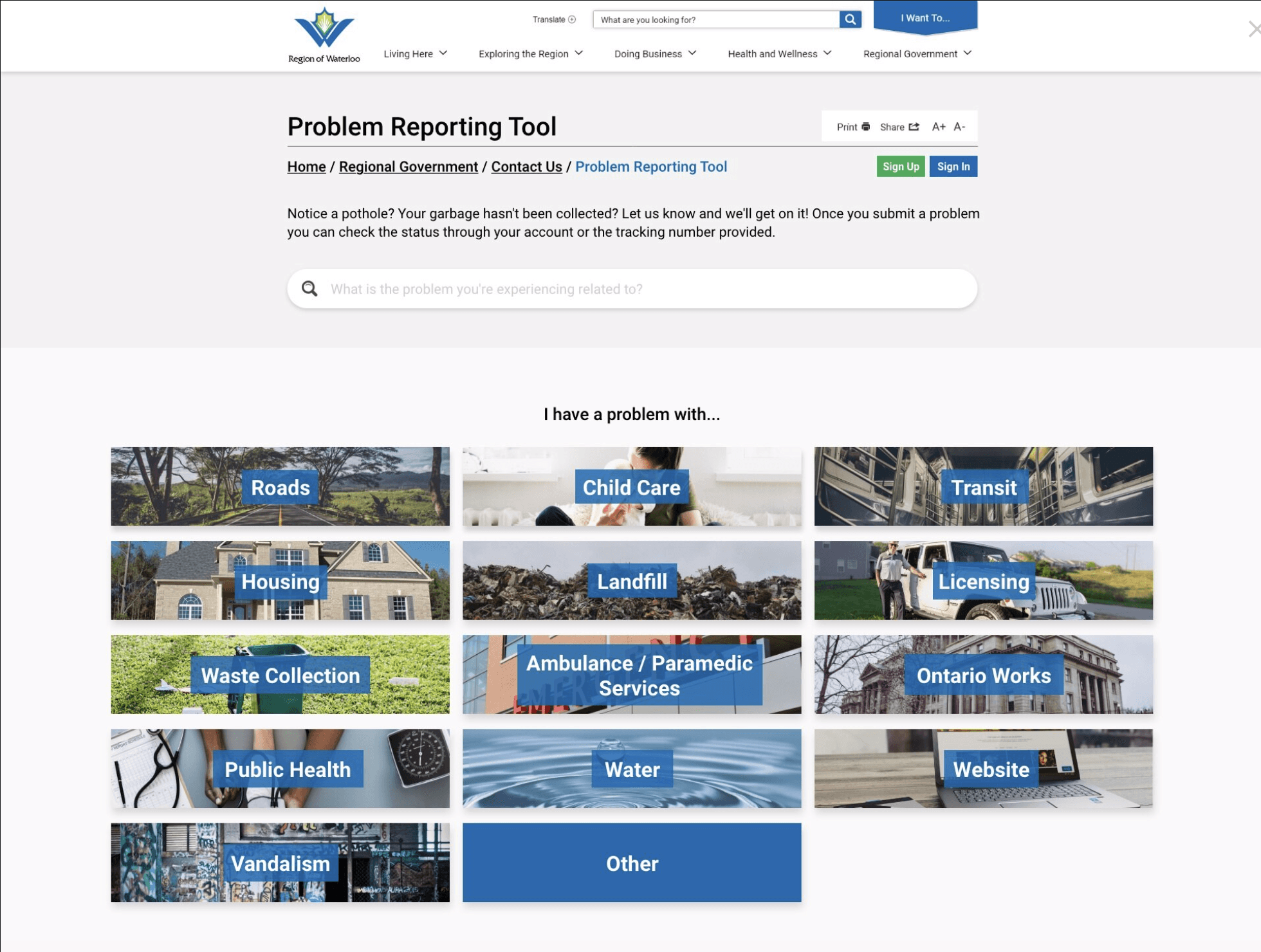
The Problem Reporting System was designed for the Region of Waterloo to improve how residents report local issues such as potholes, infrastructure damage and public service concerns.
The goal was to streamline the reporting experience, reduce friction in submitting requests and provide residents with clear visibility into the status of their reports. The solution focuses on creating a simple, accessible and transparent system that encourages community engagement and improves communication between residents and the municipality.
[Problem Statement]
Residents in the Region of Waterloo faced a fragmented and often unclear process when reporting local issues. Existing systems required multiple steps, lacked intuitive guidance and often forced users to create accounts before taking action.
Additionally, once a report was submitted, residents received little to no feedback on its status, leading to uncertainty and reduced trust in whether their concerns were being addressed.
[Role]
UX/UI Designer
[Focus]
Product Thinking
Systems Design
Student Experience
Goals & Outcomes
Primary Goal
Create a structured system that translates student experiences into clear, credible and career-ready competencies.
[Goals]
Simplify the reporting process for residents to increase ease of use.
Remove barriers to entry by allowing quick submissions without mandatory accounts.
Improve the quality and clarity of submitted reports.
Increase transparency and trust through clear status updates.
[Outcomes]
Increased completion rate of submitted reports.
Reduced time required to submit an issue.
Improved accuracy and completeness of report details.
Increased engagement with tracking and follow-up features.
[Process]
[01] Research
Complex and fragmented reporting processes discouraged use → Need for a simplified, guided reporting flow.
Mandatory account creation created friction → Need for a guest submission option to enable quick action.
Lack of clarity and feedback reduced trust → Need for structured inputs, confirmation, and tracking visibility.
[02] Ideation & Exploration
Explored a step-by-step reporting flow to reduce friction while maintaining structured data collection.
Introduced guest reporting and guided form inputs to improve accessibility and submission quality.
Mapped the end-to-end journey, leading to confirmation and tracking features to increase transparency and trust.
[03] Design Process
Designed a streamlined flow with guest entry, allowing users to quickly initiate reports without barriers.
Structured the reporting experience into clear steps (issue, location, details) with a review stage to improve accuracy.
Integrated confirmation, tracking, and error handling to ensure transparency and continuous user feedback.
[04] Testing & Iteration
Simplified the flow by reducing unnecessary steps to improve speed and ease of use.
Prioritized guest submission after identifying it as a key factor in increasing engagement.
Refined review, confirmation, and tracking features to improve accuracy, clarity and user confidence.
[Final Solution]
Simplified the reporting process with a guided flow and optional guest access.
Improved submission quality through structured inputs and a review step.
Increased trust with clear confirmation, tracking and progress updates.
[Impact]
Improved Data Quality
Structured inputs and review steps lead to more accurate and complete reports
Faster Issue Resolution
Clearer submissions help municipal teams respond and act more efficiently
Enhanced Transparency
Tracking and progress updates keep residents informed throughout the process
Stronger Public Trust
Confirmation and visibility reinforce that concerns are acknowledged and addressed
Greater Community Engagement
A more user-friendly system encourages more residents to report local issues
[Reflection]
This project reinforced the importance of designing for efficiency and clarity in task-based experiences, particularly when users are trying to complete something quickly.
A key takeaway was finding the balance between simplicity and structure, ensuring the process is easy to complete while still capturing accurate and useful information.
If I were to continue this project, I would explore integrating real-time updates and notifications to further improve transparency and keep residents informed throughout the resolution process.
[Case 03]
Problem Reporting Tool
Transforming student experiences into measurable, career-ready competencies
Problem Reporting Tool
Designing a system that bridges academic learning and real-world experience.
[Project Overview]
The Problem Reporting System was designed for the Region of Waterloo to improve how residents report local issues such as potholes, infrastructure damage and public service concerns.
The goal was to streamline the reporting experience, reduce friction in submitting requests and provide residents with clear visibility into the status of their reports. The solution focuses on creating a simple, accessible and transparent system that encourages community engagement and improves communication between residents and the municipality.
[Problem Statement]
Residents in the Region of Waterloo faced a fragmented and often unclear process when reporting local issues. Existing systems required multiple steps, lacked intuitive guidance and often forced users to create accounts before taking action.
Additionally, once a report was submitted, residents received little to no feedback on its status, leading to uncertainty and reduced trust in whether their concerns were being addressed.
[Role]
UX/UI Designer
[Focus]
Product Thinking
Systems Design
Student Experience
Goals & Outcomes
Primary Goal
Create a structured system that translates student experiences into clear, credible and career-ready competencies.
[Goals]
Clarify Student Value → Enable students to confidently articulate what they’ve learned from their experiences.
Increase Skill Visibility → Make competencies more accessible and understandable beyond traditional transcripts.
Establish Credibility → Introduce validation to ensure experiences are trusted and meaningful.
Design a Scalable System → Build a framework that can adapt across programs and institutions.
[Outcomes]
Improved Self-Expression for Students → Students can confidently translate experiences into structured skills.
Stronger Employer Understanding → Employers gain clearer insight into candidate capabilities beyond grades.
Increased Reflection & Engagement → Students become more intentional about documenting and reflecting on experiences.
Bridged Academic and Real-World Learning → Experiential learning becomes more integrated into formal education systems
[Process]
[01] Research
Complex and fragmented reporting processes discouraged use → Need for a simplified, guided reporting flow.
Mandatory account creation created friction → Need for a guest submission option to enable quick action.
Lack of clarity and feedback reduced trust → Need for structured inputs, confirmation, and tracking visibility.
[02] Ideation & Exploration
Explored a step-by-step reporting flow to reduce friction while maintaining structured data collection.
Introduced guest reporting and guided form inputs to improve accessibility and submission quality.
Mapped the end-to-end journey, leading to confirmation and tracking features to increase transparency and trust.
[03] Design Process
Designed a streamlined flow with guest entry, allowing users to quickly initiate reports without barriers.
Structured the reporting experience into clear steps (issue, location, details) with a review stage to improve accuracy.
Enabled guided inputs and sharing controls to support engagement and visibility.
[04] Testing & Iteration
Simplified the flow by reducing unnecessary steps to improve speed and ease of use.
Prioritized guest submission after identifying it as a key factor in increasing engagement.
Refined review, confirmation, and tracking features to improve accuracy, clarity and user confidence.
[Final Solution]
Simplified the reporting process with a guided flow and optional guest access.
Improved submission quality through structured inputs and a review step.
Increased trust with clear confirmation, tracking and progress updates.
[Impact]
Improved Data Quality
Structured inputs and review steps lead to more accurate and complete reports
Faster Issue Resolution
Clearer submissions help municipal teams respond and act more efficiently
Enhanced Transparency
Tracking and progress updates keep residents informed throughout the process
Stronger Public Trust
Confirmation and visibility reinforce that concerns are acknowledged and addressed
Greater Community Engagement
A more user-friendly system encourages more residents to report local issues
[Reflection]
This project reinforced the importance of designing for efficiency and clarity in task-based experiences, particularly when users are trying to complete something quickly.
A key takeaway was finding the balance between simplicity and structure, ensuring the process is easy to complete while still capturing accurate and useful information.
If I were to continue this project, I would explore integrating real-time updates and notifications to further improve transparency and keep residents informed throughout the resolution process.
[Case 03]
Problem Reporting Tool
Transforming student experiences into measurable, career-ready competencies
Goals & Outcomes
Primary Goal
Create a structured system that translates student experiences into clear, credible and career-ready competencies.
[Goals]
Clarify Student Value → Enable students to confidently articulate what they’ve learned from their experiences.
Increase Skill Visibility → Make competencies more accessible and understandable beyond traditional transcripts.
Establish Credibility → Introduce validation to ensure experiences are trusted and meaningful.
Design a Scalable System → Build a framework that can adapt across programs and institutions.
[Outcomes]
Improved Self-Expression for Students → Students can confidently translate experiences into structured skills.
Stronger Employer Understanding → Employers gain clearer insight into candidate capabilities beyond grades.
Increased Reflection & Engagement → Students become more intentional about documenting and reflecting on experiences.
Bridged Academic and Real-World Learning → Experiential learning becomes more integrated into formal education systems
[Process]
[01] Research
Complex and fragmented reporting processes discouraged use → Need for a simplified, guided reporting flow.
Mandatory account creation created friction → Need for a guest submission option to enable quick action.
Lack of clarity and feedback reduced trust → Need for structured inputs, confirmation, and tracking visibility.
[02] Ideation & Exploration
Explored a step-by-step reporting flow to reduce friction while maintaining structured data collection.
Introduced guest reporting and guided form inputs to improve accessibility and submission quality.
Mapped the end-to-end journey, leading to confirmation and tracking features to increase transparency and trust.
[03] Design Process
Designed a streamlined flow with guest entry, allowing users to quickly initiate reports without barriers.
Structured the reporting experience into clear steps (issue, location, details) with a review stage to improve accuracy.
Integrated confirmation, tracking, and error handling to ensure transparency and continuous user feedback.
[04] Testing & Iteration
Simplified the flow by reducing unnecessary steps to improve speed and ease of use.
Prioritized guest submission after identifying it as a key factor in increasing engagement.
Refined review, confirmation, and tracking features to improve accuracy, clarity and user confidence.
[Final Solution]
Simplified the reporting process with a guided flow and optional guest access.
Improved submission quality through structured inputs and a review step.
Increased trust with clear confirmation, tracking and progress updates.
[Impact]
Improved Data Quality
Structured inputs and review steps lead to more accurate and complete reports
Faster Issue Resolution
Clearer submissions help municipal teams respond and act more efficiently
Enhanced Transparency
Tracking and progress updates keep residents informed throughout the process
Stronger Public Trust
Confirmation and visibility reinforce that concerns are acknowledged and addressed
Greater Community Engagement
A more user-friendly system encourages more residents to report local issues
[Reflection]
This project reinforced the importance of designing for efficiency and clarity in task-based experiences, particularly when users are trying to complete something quickly.
A key takeaway was finding the balance between simplicity and structure, ensuring the process is easy to complete while still capturing accurate and useful information.
If I were to continue this project, I would explore integrating real-time updates and notifications to further improve transparency and keep residents informed throughout the resolution process.
Problem Reporting Tool
Designing a system that bridges academic learning and real-world experience.
[Project Overview]
The Problem Reporting System was designed for the Region of Waterloo to improve how residents report local issues such as potholes, infrastructure damage and public service concerns.
The goal was to streamline the reporting experience, reduce friction in submitting requests and provide residents with clear visibility into the status of their reports. The solution focuses on creating a simple, accessible and transparent system that encourages community engagement and improves communication between residents and the municipality.
[Problem Statement]
Residents in the Region of Waterloo faced a fragmented and often unclear process when reporting local issues. Existing systems required multiple steps, lacked intuitive guidance and often forced users to create accounts before taking action.
Additionally, once a report was submitted, residents received little to no feedback on its status, leading to uncertainty and reduced trust in whether their concerns were being addressed.
[Role]
UX/UI Designer
[Focus]
Product Thinking
Systems Design
Student Experience